

Join us in the fight against ALS today!


Current Donations: $27,061 * $6.44 per Mile *
Day 15 West Glacier to East Glacier
July 23, 2026
Indigenous Homeland
East Glacier stands immediately adjacent to the Blackfeet Reservation and within the ancestral homeland of the Blackfeet Nation (Niitsitapi). For countless generations, the Blackfeet lived across the northern Great Plains and the eastern slopes of the Rocky Mountains, following buffalo herds and maintaining extensive trade networks.
The mountains immediately west of East Glacier are sacred in Blackfeet tradition. They are woven into creation stories, ceremonies, and oral history. The Blackfeet refer to this region as the Backbone of the World, recognizing it as both a physical and spiritual center of their homeland.
With Steve on his way home via train, today represented the first solo ride for Terry. The cycling trek was another challenging ride due to both traffic and terrain. There were sections of road with no shoulder at all, but most drivers were courteous. Early start at 06:00 allowed for a great view of the sunrise. Unfortunately, it was smokey enough to require a mask for most of the day which is very inconvenient.
It was a climbing day that included Maria Pass the summit for the continental divide. Sherpa-Di would drive 10-miles ahead and wait with cold water, snacks and sandwiches to keep me fueled. Over the prior two weeks, she had developed the ability to look Steve and I in the eye and say Steve you need to eat protein now. Terry, you need some carbs and water. Endurance sports for me make me NOT hungry while riding, so I have to force food down. I don’t think I am unique with this trait, Steve was the same way, but it is very challenging to gulp down food when there is no sense of hunger. Of course, we both felt better once we ate, but it seems counter intuitive to have to force food to keep functioning.
While riding through a very rough section of construction, I spotted the van, and Diane was hailing me over to stop. I made my way over into the parking lot of a small motel where Diane and a man in a pink tee shirt were conversing. I noticed that he had his cell phone pointed at me and he was recording my arrival and then proceeded to interview me about the ride, ALS and why it is we were doing this. His name was Robert and he knew the ravages of ALS. He said he would contribute on-line and he would send his video to his friend group. Then he said, “wait just a minute, I have something I want to give you.” And disappeared into his room. After several minutes, he returned with a look of disappointment saying that he couldn’t find it. He revealed that he had been a Catholic priest in his past and had been carrying a rosary for years and he wanted us to have it. Diane soothed his disappointment by telling him to pray the rosary for us, that was as good as giving us the rosary. This conversation was a Catholic one that I am not familiar with, but he agreed with her statement and gave us both a hug and we were on our way. Diane was raised Catholic.
We had a lengthy stop at the continental divide monument with food, water and many photos. Then Diane drove down the road 10 more miles. From this point forward, most of the terrain was downhill. While I was gleefully coasting down the long descent with a big smile on my face. I looked to my left side and saw a BNSF train coming up the hill that I was going down. Like a silly kid, I did the sign to encourage the engineer to blast his horn. To my surprise, he hit the horn and gave me a double blast. I felt seen and acknowledged as they passed and I was flying down the hill close to 40mph. It was a little celebration for making it to the top.
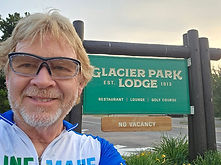
We stayed at the historic Glacier Lodge in East Glacier. An impressive structure made with whole trees used as columns three floors high. The interior columns (trees) are complete with bark. Naturally, our room was on the third floor. No elevators at this historic building so lugging everything upstairs was required The doorman helped carry most of it, but the irony of riding and then staying on the third floor was not lost. We arrived earlier than normal check in time. ~1:00pm. Diane did her rapport building and spoke with the front desk about our mission. As it turns out the receptionist is a bio-chem student at University of Montana and is doing research with a company for a cure for ALS. This information was yet another coincidence that seems to be occuring on this ride. She made the first room available to us, so I had access to a shower, but…it was on the third floor. Give and take.
In the lobby, if you could call this grand hall a lobby, was a Blackfoot man selling traditional "ledger paintings." These became a thing, he told me, after Little Big Horn, when tribes were rounded up, the only paper available to use was from old ledgers and books. The art is painted or drawn on top of whatever else was on the page. He gave me his card, in return I gave him our Blaine to Maine card and we talked about the ride. He looked closely at the logo and said "Is that bear riding the bicycle?" I said "No, it's Sasquatch." By this time Diane had come over and he told us about his grandmothers encounters with bigfoot. "Bigfoot is real" he told us, and then explained his theory about it's origin. A great way to end the day.
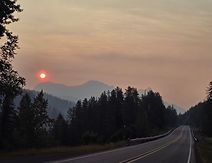
Early Morning Departure
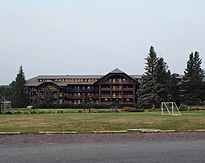
Lodging Secured
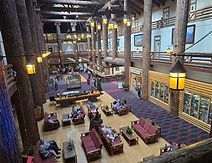
The Meeting Place
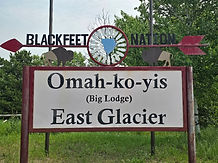
Haiku of the Day
The iron snake drifts
permanent rails tied to Earth
Nation's commerce flows
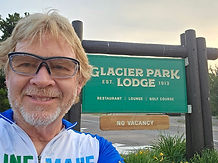
The RIder
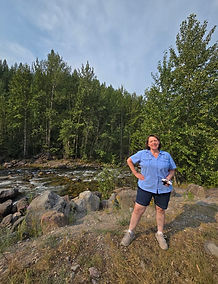
Sherpa-Di
Day 16 East Glacier to Valier, MT
July 25, 2026
Indigenous Homeland
Valier lies within the traditional homeland of the Blackfeet Nation, where the sweeping prairie once supported immense buffalo herds that sustained generations of Blackfeet families.
The open grasslands demanded an intimate understanding of weather, wildlife, water, and seasonal movement. Buffalo provided food, clothing, shelter, tools, and spiritual significance, making the prairie itself central to Blackfeet life.
For the Blaine to Maine rider: As the Rockies fade in your mirrors, remember that these grasslands were every bit as important to Indigenous life as the mountains behind you.
Day 17 – East Glacier to Valier
This was the second solo ride since Steve's departure.
We carried our belongings down the stairs without assistance because we were up too early for the doorman. Wheels rolled at 6:30 a.m.
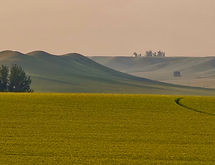
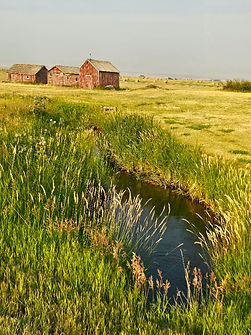
Today's ride marked the transition from the mountains to the high plains. We said goodbye to the trees and hello to prairie vegetation, which quickly gave way to agricultural fields and oil wells. The roads were straight, with wide shoulders and plenty of easy pullouts for Diane. Although the overall elevation from East Glacier to Valier was downhill, there were still plenty of rolling hills to keep things interesting. A smoky haze lingered throughout the day and irritated my eyes, but it wasn't bad enough to need a mask.
I'm a tree guy, so the complete absence of trees is a new environment for me. While riding, I always pay attention to the wildlife I encounter and the interactions between people and animals. Today, two experiences with birds really stood out.
At one point, I kept hearing a red-winged blackbird calling. I looked up to my right and found a pair flying alongside me, only 10 to 15 feet away. At first, I assumed they were defending a nearby nest and trying to chase me off, but instead they stayed with me for nearly a quarter mile down the road.
Later, something similar happened with another bird I couldn't identify. It had a long beak, almost like an ibis, and reminded me of a seabird. Again, there was a pair of them. As I rode along at about 20 mph, they criss-crossed over my head, called back and forth to each other, then dropped down to eye level as if they were looking me over before climbing back into the air. They stayed with me for about half a mile. It was fascinating behavior and, in an odd way, surprisingly comforting.
Today Diane and I decided to meet every 10 miles since both the terrain and the winds were new to us. That plan worked well. By 11:00 a.m. the temperature was climbing rapidly, and when I rolled into Valier around 1:00 p.m., it was about 105°F. The winds kept things interesting—headwinds at times, tailwinds at others, but mostly relentless crosswinds. With almost no curves or changes in direction, the roads seemed to stretch endlessly toward the horizon.
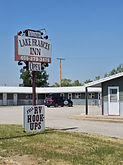
Diane had developed a migraine and called the town's only motel to see if we could check in early so she could lie down. During the conversation, the woman at the front desk, Elizabeth, asked about the ride. After hearing why we were crossing the country, she shared that the motel owner had recently lost a friend to ALS and that another close friend is currently living with the disease. Nancy said she was going to contact the owner to see if he might like to make a donation.
The connections never seem to stop.
There hasn't been a single day on this ride when we haven't heard someone's personal story about ALS. Every conversation reinforces how many lives this disease touches. I look forward to the day when those conversations are no longer about loss or struggle, but instead about the cure that was discovered.
We found the town's one and only grocery store before it closed at 5:00 p.m. and picked up breakfast and lunch for tomorrow. Then we walked across the street to the one and only café and enjoyed breakfast for dinner.
It's amazing what the body craves after a long day in the saddle.
Day 17 Valier to Great Falls, MT
July 25, 2026
Indigenous Homeland
Great Falls occupies one of the most important crossroads in the northern Plains. The falls of the Missouri River were known to many Indigenous nations, including the Blackfeet, Gros Ventre (Aaniiih), Assiniboine (Nakoda), Cree, Crow (Apsáalooke), and others.
The series of waterfalls required travelers to portage canoes around the river, making the area a natural gathering place for trade, diplomacy, and cultural exchange.
For thousands of years, people met here to exchange goods, renew alliances, and share knowledge.
Day 18 – Valier to Great Falls
We're getting into the groove of riding solo again, and Diane is settling into supporting just one rider.
I believe this was our hottest day so far. I drank no fewer than 10 bottles of water that Diane kept chilled for me. She was battling another migraine, so we decided to meet every 7 to 10 miles. That way, if the heat became too much, I could bail out and ride in the van. Likewise, if Diane's migraine worsened, I could drive the remainder of the route while she rested.
The plan worked well because I was drinking water like a horse at a trough.
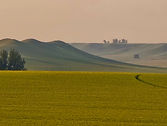
The first 20 miles were blissful—gentle rolling hills, light traffic, and easy riding. Then a few road changes brought us back to busy highways where commerce was once again on full display.
At one of our scheduled stops, I spotted the van parked in a gravel driveway. When I pulled over, Diane was talking with the owner of the property. He had driven his ATV over to the van where the driveway met the highway to make sure she was okay.
As she explained the ride, the gentleman, Brad, reached into his pocket and handed Diane $40.
Then he paused and said, "Wait... I can do better than that. I just came from a cancer fundraiser for a friend, and I have my checkbook with me."
He proceeded to write a check for $100, much to Diane's amazement.
As we continued talking, Brad shared that he had recently lost a nephew to ALS. It was still a fresh, painful wound. He told us about the road ahead and then smiled as he said, "The road to Lewistown is so hot that the jackrabbits carry a bottle of water!"
He also told me that the only thing I had to worry about today was the rivers.
"Rivers?" I asked.
He pointed toward the highways stretching to the horizon in both directions.
"Those rivers."
Those I can handle but, you've got wind!
Without saying another word, he turned and pointed to an enormous cottonwood tree with a massive limb that had been snapped off.
"Yeah," he said. "We have wind."
He explained that those old cottonwoods had stood there since the homesteading days. Looking at that broken limb, I believed him.
It was one of those conversations that none of us wanted to end, but the miles weren't going to ride themselves. We took a few photos, thanked Brad for his generosity, and continued east. Thank you Brad, for the conversation and the humanity.
A few miles later we rolled into the tiny town of Brady. Once again I found Diane waiting near the post office while I topped off on water.
As I was drinking water, a man backed out of the gravel parking lot, pulled alongside me, rolled down his window, and asked, "You aren't one of those crazy people who ride coast to coast, are you?"
That gave me the perfect opportunity to explain what we were doing.
After deciding that I was, in fact, one of those crazy people, he told me that every year a group from "some college in Washington" rides across the country and comes through Brady. He said they pass through over about three days because riders spread out according to their speed.
I assured him I was riding alone and that I was definitely no college kid.
The ride would probably be a lot easier if I were.
For the rest of the day, I found myself thinking about all those college cyclists who have ridden this same stretch of road over the years. It's remarkable that such a tiny town has quietly become part of so many cross-country adventures.
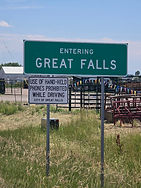
As the miles piled up, so did the temperature. By the time I rolled into Great Falls, I was dragging. The day's total came to 80.6 miles and the temperature was over 100F.
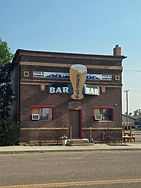
We treated ourselves to dinner at Clark & Lewie's Café. Our waitress suggested that after dinner we head upstairs to visit the famous Sip 'n Dip Lounge. The bar overlooks an indoor swimming pool through a large glass wall, where two mermaids entertained the patrons while they enjoyed tropical drinks.
We settled into a comfortable hotel that night and enjoyed some much-needed sleep before the alarm sounded at 3:30 a.m. We wanted to be back on the road at first light.
_resized.jpg)
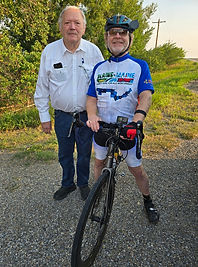
Brad and Terry
Day 18 Great Falls to Stanford, MT
July 26, 2026
Indigenous Homeland:
Stanford sits where the mountain front gives way to the rolling plains, an area traditionally used by the Blackfeet, Crow, Gros Ventre, and Assiniboine peoples.
Rather than belonging exclusively to one nation, this landscape served as seasonal hunting grounds and travel corridors. Buffalo migrations influenced where people camped, hunted, and gathered throughout the year.
Day 19 Stanford to Lewiston, MT
July 27, 2026
Indigenous Homeland:
Lewistown lies near the geographic center of Montana in an area long shared by several Plains peoples, including the Crow (Apsáalooke), Blackfeet, Gros Ventre, Assiniboine, and Northern Cheyenne.
The nearby Judith Basin and surrounding foothills provided rich hunting grounds and important travel routes between the Missouri River and the mountain front.
Haiku of the day
Day 20 Lewistown to Winnett, MT
July 28, 2026
Indigenous Homeland:
Winnett lies within the broad homeland of the Northern Cheyenne, Crow, and Assiniboine peoples.
The vast prairie surrounding Winnett once supported enormous buffalo herds. Indigenous life here required extraordinary knowledge of water sources, prairie ecology, weather, and animal behavior.